
2025 Nonprofit Policy Moments and a 2026 Look Ahead
The Nonprofit Alliance (TNPA) was proud to engage with policymakers regarding important legislative and policy moments in 2025. As we move into 2026, a midterm election year, it is an important time to reflect on some of the key policy moments for the nonprofit sector, highlighting both successes and challenges. We remain grateful to TNPA members for their support of our advocacy engagement and for sharing their individual and organizational perspectives to help shape our work.
Top Five Policy Moments in 2025 for the Nonprofit Sector:
DOGE Cuts and a Government Shutdown:
The Department of Government Efficiency (DOGE) swept into the early part of 2025 with massive cuts to individual agencies, eliminating the U.S. Agency for International Development (USAID), and cutting or eliminating grants across the nonprofit sector, from health research to direct service provisions.
On October 1, the longest government shutdown in U.S. history began. We warned that this shutdown would be different from previous ones and spoke of the compounding impacts on an already stretched nonprofit sector. We later detailed the kinds of services that were hit the hardest, the bureaucratic delays for grant approvals, and the expectations on the nonprofit sector to fill service gaps.
While much of the focus during the government shutdown was rightly on immediate humanitarian needs, notably around food assistance and the Supplemental Nutrition Assistance Program (SNAP), this was a critical time to also reiterate the scale and scope of the nonprofit sector’s contributions to our society. Some of this work may not be immediately visible in our daily lives but is foundational to our communities. Programs include lifesaving medical research, historical preservation, emergency disaster response, legal support services, animal welfare, visual and performing arts, health services, environmental protection, and educational training, among many other areas.
Data Privacy Federal Legislation:
With some House members of the Energy and Commerce Committee stating interest in drafting new legislation on comprehensive data privacy and the announcement of the House Data Privacy Working Group in February, we worked with key offices on Capitol Hill to provide early and substantial policy priorities on data privacy. We clearly addressed the justification for a federal law as opposed to the existing piecemeal approach by individual states.
During our October 21 Advocacy Day, we met with key Senate and House offices who are members of the Data Privacy Working Group and with the House Energy and Commerce committee staff. We expect a House bill text in early 2026.
Charitable Deduction ($1000/$2000):
On July 4, the new tax and spending bill was signed into law, including a version of the Charitable Act, which provides a tax deduction of $1,000 for individual tax filers and $2,000 for married couples filing jointly for all taxpayers, regardless of their level of income. The permanent provision is effective January 1, 2026. The Senate increased the amounts from the original House proposal of $150/$300, with foregone revenue (cost to the government in lost tax revenue) balanced by a 0.5% adjusted gross income (AGI) floor for itemizers. Importantly, we commissioned rapid-response research in the midst of the Congressional negotiations to demonstrate the likely impact of the unprecedented AGI floor, compelling data that made the case against the originally proposed 1-2%. Overall, this is a critical piece of legislation that encourages all American taxpayers to give more to charitable organizations that support communities in need, and we’re proud of what we accomplished in broad coalition to support this successful inclusion. Our blog post in July detailed what the bill’s tax reform means for charitable giving.
Combined Federal Campaign (CFC):
The Combined Federal Campaign (CFC) was created in 1964 to enable charitable giving from federal civilian, military, and postal employees. We successfully led, with coalition support, an effort to keep out of the reconciliation bill a proposed 10% administrative fee on federal employee payroll deductions.
In late August, we learned that the Office of Personnel Management (OPM) had put a pause on the CFC with likely intent to end it. We worked in coalition on messaging to the administration and the Hill, notably leading a September 4 sign-on letter with nearly 400 nonprofit organizations. We also activated an alert to our members and supporters to contact their Members of Congress to protect the Combined Federal Campaign.
On September 10, OPM announced that the CFC would continue and begin on October 1, as previously scheduled. In its announcement, OPM conveyed skepticism for the CFC and questioned its efficiency. It is clear that our collective advocacy pressure was felt, and our focus on key Senate offices also helped convey supportive CFC messaging to the White House. We submitted a thank-you letter to OPM, copying Hill leadership, with nearly 400 nonprofit organizations signing on.
As predicted, the government shutdown impacted the October 1 start date of the 2025 CFC and caused the campaign to miss multiple weeks of fundraising. Continuing our coalition effort, we circulated a sign-on letter to the Director of the Office of Personnel Management, requesting an extension of the campaign timeline. The decision on the continuation of the CFC for 2026 is expected early in the new year.
Elevated scrutiny of the nonprofit sector:
The White House has implemented additional targeting of the nonprofit sector, building on earlier questioning by the administration and some members of the House and Senate regarding nonprofit programmatic decisions and hiring approaches. We believe that the nonprofit sector must retain its autonomy and oppose this unwarranted scrutiny.
The September 25 Presidential Memorandum titled “Countering Domestic Terrorism and Organized Political Violence” raised significant concerns for nonprofit organizations, echoing earlier troubling policy actions and rhetoric taken by this administration and Congressional legislative actions. The memo described a new National Joint Terrorism Task Force (JTTF) and a resulting law enforcement strategy. The JTTF will investigate participants in “criminal conspiracies” with little justification for how such organizations or participants would warrant such scrutiny.
In addition, the Wall Street Journal reported on October 15 that planned changes at the IRS will enable politically motivated investigations of nonprofit organizations and their donors. The article describes plans to install allies at the IRS criminal-investigative division, weaken the involvement of IRS lawyers in criminal investigations, and potentially target specific left-leaning groups and donors.
In the spring, we detailed the trend of the politicization of the tax-exempt status and later called out the scrutiny of the nonprofit sector and communicated clear compliance guidelines for nonprofit organizations.
Artificial Intelligence (AI):
AI provides both opportunities and challenges for the nonprofit sector, but AI implementation and usage are moving faster than oversight regulation. We endorse the data ethics framework established by Fundraising.AI, which aligns with local, regional, and international standards and human-rights–based principles, affirming donor and beneficiary rights and elevating dignity, non-manipulation, and fairness as non-negotiables to help the sector innovate responsibly and scale good work without eroding trust.
At the end of July, the Trump administration released its AI action plan, following up from its earlier Executive Order this year, “Removing Barriers to American Leadership in Artificial Intelligence”. The plan was more detailed than anticipated but some of the expected provisions were: focused on the infrastructure/data center section (jobs), pushed for a lack of oversight, and threatened retribution for states that regulate. Additionally, the administration’s definition of bias may be counter to the perspective of many nonprofits.
President Trump is continuing his AI Action Plan, with this November 24 Executive Order on using AI for scientific discovery and the December 11 Executive Order (EO), Ensuring a National Policy Framework for Artificial Intelligence. In response to the promise of retaliation on states that regulate AI, a bipartisan group of 35 State Attorneys General, and DC, pushed back with a clear message to Congressional leaders.
A Lookahead for the Nonprofit Sector in 2026:
●The nonprofit sector will face ongoing scrutiny through Congressional oversight and possible steps by the administration, including EO implementation.
●As this will be a midterm election year, the first two quarters of the 2026 Congressional calendar will be critical timing to introduce new legislation, educate Congressional members and staff on the nonprofit funding challenges that will carry over, and to fight back on unsubstantiated targeting of the nonprofit sector. The current continuing resolution ends on January 30, 2026, and another government shutdown is, unfortunately, still a possibility.
●We have reported previously on federal litigation which may affect the Johnson Amendment, the law that prohibits 501(c)(3) nonprofits from participating in partisan elections. A court decision is expected in the first quarter of 2026.
●Regarding Artificial Intelligence (AI), the implementation of the EOs described above and ongoing legislative initiatives and policy statements are expected. We will continue to flag issues of concern raised publicly by members of both parties, such as child safety and the spreading of misinformation and/or falsehoods. As with data privacy regulations, we assert that a single national standard for AI development, use, and compliance oversight is ideal, provided that it meaningfully addresses and ensures the responsible and ethical use of AI. We give a comprehensive federal bill on AI a low likelihood in 2026.
●Due to the 2025 funding cuts to the nonprofit sector and the compounding nature of additional service gaps that the sector filled during the 2025 government shutdown, we anticipate additional funding challenges for nonprofit organizations in 2026, which may include staffing and service cuts.
We look ahead to 2026 with determination and purpose. Thank you for your support of our work and please visit our website to stay updated on our current publications, policy updates, and events.

Author: Ann Hollingsworth
Ann Hollingsworth is the VP, Government Affairs for The Nonprofit Alliance.
Related Posts
Building Leadership Clarity at TNPA’s Leadership Summit 2026
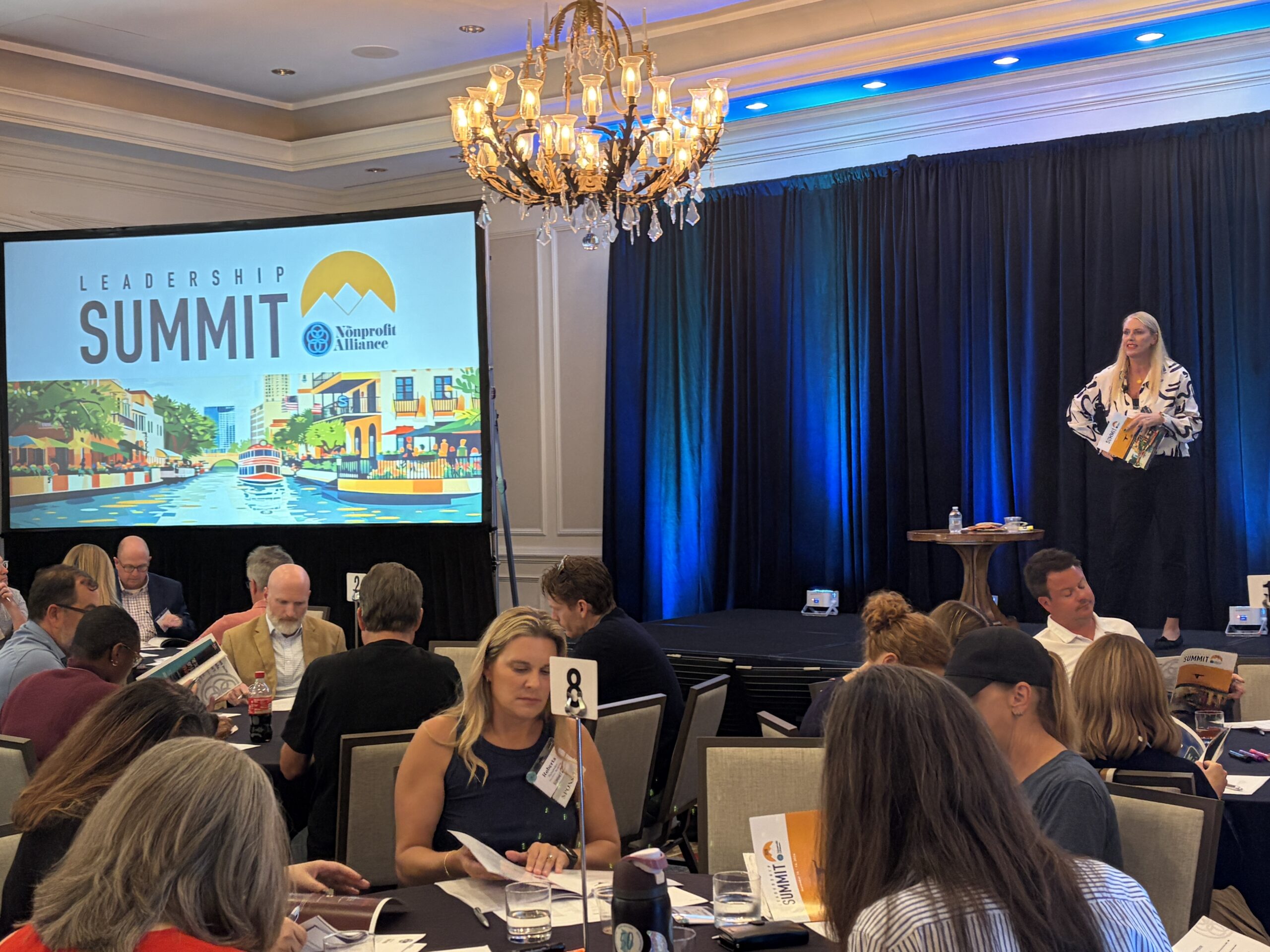
The team at The Nonprofit Alliance (TNPA) is thrilled to be in San Antonio, Texas, this week with more than 170 senior leaders from across the nonprofit sector. Against the backdrop of the beautiful Riverwalk, TNPA’s Leadership Summit 2026 has brought together a remarkable group of changemakers for an intensive, action-oriented experience designed to strengthen leaders, their teams, and the broader sector.

Leading EDGE Updates | August 2026
Check out our latest TNPA blog post for quarterly updates, including ways to get involved with our community of nonprofits, nonprofit-supporting companies, schools, and students who are passionate about making a difference through the social good sector!
Artificial Intelligence (AI) Policy Update
TNPA continues to work with policymakers regarding ethical AI priorities and we are closely tracking the implementation of the President’s AI plans.
We are also engaging our membership on educational opportunities as they navigate this fluid landscape, speaking with our nonprofit and commercial members regarding policy priorities which include…