
Protect Nonprofits
This page documents The Nonprofit Alliance’s ongoing efforts to protect the independence, integrity, and mission of the nonprofit sector from political interference and unwarranted targeting. Here you’ll find updates on our advocacy work with Congress, our monitoring of legislative and executive actions that threaten nonprofit operations, and our response to policies that undermine the sector’s ability to serve communities. We track critical developments, from tax policy changes affecting charitable giving to attempts at politically-motivated revocation of tax-exempt status, and detail our bipartisan engagement to defend the legal frameworks that allow nonprofits to operate free from political pressure. This resource serves as both a transparency tool for our members and stakeholders and a call to action to preserve the nonprofit sector’s essential role in American civic life.
New Proposed Rule: Racial Nondiscrimination & 501(c)(3) Status
The Treasury Department and the IRS have issued proposed regulations on racial nondiscrimination requirements for private educational institutions holding 501(c)(3) status, grounded in the Supreme Court’s Bob Jones University v. United States “fundamental public policy doctrine.”
The rule applies to K–12 schools, colleges, universities, and professional/trade schools. A school risks losing tax-exempt status for discrimination in admissions, scholarships, athletics, or other school-supported programs based on race, color, or national/ethnic origin. See the full rule here and public comments will be allowed for 60 days after the Federal Registration publication date.
The proposal is confined to private educational institutions rather than the broader 501(c)(3) community but could have larger implications for the nonprofit sector.
𝐆𝐨𝐨𝐝 𝐍𝐞𝐰𝐬 𝐟𝐨𝐫 𝐚 𝐃𝐞𝐥𝐚𝐲 𝐨𝐟 𝐭𝐡𝐞 𝐎𝐌𝐁 𝐑𝐮𝐥𝐞𝐦𝐚𝐤𝐢𝐧𝐠 𝐨𝐧 𝐅𝐢𝐧𝐚𝐧𝐜𝐢𝐚𝐥 𝐀𝐬𝐬𝐢𝐬𝐭𝐚𝐧𝐜𝐞!
The Senate’s continuing resolution (CR) was passed on August 8 and included a delay in the implementation of the proposed OMB financial assistance rules through December 11. The House passed the Senate CR bill and President Trump signed it into law on September 2. Call to Action: While we applaud the delay through December 11, keep reaching out to your Members of Congress to share your concerns about this proposed OMB rulemaking change.
𝐓𝐡𝐞 𝐎𝐌𝐁 𝐩𝐫𝐨𝐩𝐨𝐬𝐚𝐥 𝐰𝐨𝐮𝐥𝐝 𝐠𝐢𝐯𝐞 𝐟𝐞𝐝𝐞𝐫𝐚𝐥 𝐚𝐠𝐞𝐧𝐜𝐢𝐞𝐬 𝐧𝐞𝐰 𝐩𝐨𝐰𝐞𝐫 𝐭𝐨 𝐚𝐰𝐚𝐫𝐝 𝐨𝐫 𝐝𝐞𝐧𝐲 𝐠𝐫𝐚𝐧𝐭 𝐟𝐮𝐧𝐝𝐢𝐧𝐠, 𝐰𝐡𝐢𝐜𝐡 𝐜𝐨𝐮𝐥𝐝 𝐫𝐞𝐬𝐮𝐥𝐭 𝐢𝐧 𝐟𝐮𝐧𝐝𝐢𝐧𝐠 𝐝𝐞𝐜𝐢𝐬𝐢𝐨𝐧𝐬 𝐛𝐚𝐬𝐞𝐝 𝐨𝐧 𝐚𝐬𝐬𝐮𝐦𝐞𝐝 𝐩𝐨𝐥𝐢𝐭𝐢𝐜𝐚𝐥 𝐩𝐞𝐫𝐜𝐞𝐩𝐭𝐢𝐨𝐧𝐬, 𝐫𝐚𝐭𝐡𝐞𝐫 𝐭𝐡𝐚𝐧 𝐚 𝐭𝐫𝐚𝐜𝐤 𝐫𝐞𝐜𝐨𝐫𝐝 𝐨𝐟 𝐝𝐞𝐥𝐢𝐯𝐞𝐫𝐢𝐧𝐠 𝐫𝐞𝐬𝐮𝐥𝐭𝐬.
TNPA submitted public comments alongside coalition partners, urged our members to sign on to the coalition letter led by National Council of Nonprofits, and activated a Call to Action to email Members of Congress to express concerns and ask for support of the sector.
Call to Action! OMB Grants and Rules Proposal
The Office of Management and Budget (OMB) has proposed a major rewrite of the rules governing federal grants and financial assistance.
The nearly 400-page proposal could significantly reshape how nonprofits access and maintain federal funding by expanding agency discretion over grant decisions, increasing political review of awards, and creating new compliance obligations for recipients.
The Nonprofit Alliance is working with coalition partners to raise these concerns before the July 13 comment deadline and TNPA will be submitting its own comments.
What can you do today?
- Please consider signing on to National Council of Nonprofits’ opposition letter, which TNPA supports. Deadline for the letter is July 13: https://lnkd.in/e2iBJBnp
- Contact your Members of Congress to share your concerns! See more information and the form here.
Why this matters: Coming amid ongoing concerns about funding freezes, delayed awards, and heightened scrutiny of nonprofit organizations that TNPA has been highlighting, this proposal raises important questions about transparency, consistency, and access to federal funding.
Democrats Launch Inquiry into the IRS
On April 14, Rep. Lloyd Doggett (D-TX), Ranking Member of the House Ways & Means Health Subcommittee, and Rep. Terri Sewell (D-AL), Ranking Member of the Ways & Means Oversight Subcommittee, “led most Ways and Means Committee Democrats in demanding immediate answers from IRS Chief Executive Officer Frank Bisignano on reports that the IRS has compiled a list of Democratic donors and “left-leaning” nonprofit organizations, and is moving to label these groups as domestic terrorists.” See the full press release here. The letter to the Chief Executive Officer of the IRS may be found here, which details specific questions for response by April 29.
The letter expands on previously raised concerns about the administration’s rhetoric and policy announcements around weaponizing the IRS against nonprofit organizations and those that may disagree with the administration’s actions. The Nonprofit Alliance has raised some of these concerns as well and will continue to message the imperative of a non-partisan Internal Revenue Service.
Johnson Amendment
Johnson Amendment Court Case Update:
The March 31 decision by United States District Judge J. Campbell Barker, United States District Court for the Eastern District of Texas, tossed out the proposed settlement between the IRS and religious organizations. In the ruling, the judge concluded that the agreement reached was not in keeping with existing law. The appeal process is expected to move forward. See the Nonprofit Times article for additional information.
Overview
The press has drawn considerable attention to the Internal Revenue Service’s court filing that supports a narrow exception to the Johnson Amendment for religious organizations. The Johnson Amendment was passed by Congress in 1954 and prohibits charities and churches from engaging in political campaign activity. The immediate effect of the case is limited to two churches in Texas (the named plaintiffs) and permits political endorsements so long as they occur in the usual course of communications with congregants. However, there is widespread concern and debate that the permission could subsequently be applied to 501(c)(3) organizations more broadly.
Action Alert: Proposed Rule for Federal Funding Recipients
The U.S. General Services Administration has proposed a new rule that would require all federal funding applicants to sign new certifications under penalty of civil and criminal law when registering or renewing in System for Award Management (SAM.gov), the federal portal used to apply for and manage federal funding. The certifications are tied to executive orders and federal guidance on issues including DEI, immigration, and terrorism.
Why This Matters to You
If implemented, this rule could:
• Create legal and compliance uncertainty for nonprofits
• Expose organizations to audits or investigations based on vague standards
• Result in increased scrutiny of the nonprofit sector
• Disrupt services, particularly those serving minority communities
What You Can Do
1. Submit public comment by March 30. Suggested issue areas to highlight include:
• Lack of clarity for nonprofits regarding their compliance requirements
• Concerns about aligning with the Department of Justice guidance and executive orders on DEI
• Risks of legal harassment and wasted organizational resources responding to investigations
• Expected disruptions to essential nonprofit services.
2. Sign the national coalition letter opposing this rule by March 30.
TNPA will continue to provide updates to our members on this important issue.
February 11, 2026 | CEO-level Hill Day
On February 11, The Nonprofit Alliance (TNPA) hosted CEO-level meetings with Members of Congress and senior staff. The purpose of the day was to discuss nonprofit sector challenges, highlight service provisions, detail current workforce constraints, and to provide relevant data to help inform ongoing policy discussions. Following a substantive breakfast discussion with the Co-Chairs of the Philanthropy Caucus, Rep. Blake Moore (R-UT-01) and Rep. Danny Davis (D-IL-07), our group met with Rep. Beyer (D-VA-08), Senator Lankford (R-OK), and senior staff with House Majority Leader Scalise (R-LA-01) and House Democratic Leader Jeffries (D-NY-08).
This was a wonderful opportunity to raise visibility on the substantial work in our sector, to sincerely thank our nonprofit champions in Congress, and to continue our strong bipartisan advocacy.
Targeting of the Nonprofit Sector
On October 15, 2025, The Wall Street Journal reported on detailed plans for changes at the IRS, which would include installing administration allies at the IRS criminal-investigative division, weaken the involvement of IRS lawyers in criminal investigations, and potentially target specific left-leaning groups and donors. This represents a dangerous politicization of regulatory power. See more of Shannon McCracken’s response here.
Members of Congress are responding to these reports, notably with this letter from 14 U.S. Senators to the IRS senior leadership, raising concerns about these plans.
The September 25, 2025, Presidential Memorandum titled “Countering Domestic Terrorism and Organized Political Violence” raises significant concerns for nonprofit organizations that echo earlier troubling policy actions and rhetoric taken by this administration and Congressional legislative actions. The memo describes a new National Joint Terrorism Task Force (JTTF) and a resulting law enforcement strategy. The JTTF will investigate participants in “criminal conspiracies” with little justification for how such organizations or participants would warrant such scrutiny. See TNPA’s full statement by Shannon McCracken here.
While this Presidential memo does not represent a legal change, the memo and the planned changes at the IRS are the latest examples of the unwarranted targeting of the nonprofit sector. TNPA continues to raise awareness and concerns through engagement with policymakers, media engagement, and public statements.
July 25, 2025 | Rescissions Package Signed into Law
The $9 billion rescissions package passed the Senate on July 17, the House on July 18, and was signed into law by the President. The funding was primarily for foreign aid and public media. Senators adopted a Republican substitute to take out a $400 million rescission for PEPFAR (President’s Emergency Plan for AIDS Relief) but other amendments to weaken the scope of the overall package failed.
July 4, 2025 | The Tax & Spending Bill Becomes Law
The tax and spending legislation, originally titled “One Big Beautiful Bill,” was signed into law at the White House on July 4 with a number of provisions impacting the broad nonprofit sector. Read our Tax Reform & Charitable Giving: What It Means for Your Organization and Donors blog post for more details.
April 22, 2025 | The Threat of Politically-Motivated Revocation of Tax-Exempt Status
The Nonprofit Alliance would strongly oppose any executive order or action that would revoke the 501(c)(3) tax-exempt status of nonprofit organizations based on their misalignment with a current administration’s priorities or values. Such an act would:
- Allow the executive branch to unilaterally penalize organizations without due process, bypassing established legal frameworks
- Create a mechanism for labeling legitimate community organizations as problematic without evidence or judicial review
- Circumvent legislative authority by using executive power to redefine tax exemption criteria established by Congress
The real impact of such action would be felt in communities across America where nonprofits provide essential services. Organizations could be targeted for working with populations or on issues that an administration finds politically inconvenient, and be forced to reduce essential programs and services, reduce operational capacity, divert resources to legal challenges rather than mission fulfillment, and potentially close entirely, creating service gaps in vulnerable communities.
Just as it was wrong in 2013 when the IRS used keywords like “Tea Party” to select organizations for additional scrutiny, an action such as this would institutionalize the weaponization of government authority. It would create a system where any administration could label organizations they disagree with as problematic without substantive proof, and establish a dangerous precedent that could be expanded by future administrations to target an ever-widening circle of organizations.
Tax-exempt status is a legally defined classification, not a political tool that changes with each administration.
The nonprofit sector’s strength lies in its ability to address community needs independently of political pressures.The Nonprofit Alliance believes that presidential administrations must respect the established legal framework governing nonprofit organizations. We urge all federal officials to uphold the sector’s independence from political interference and protect the vital services nonprofits provide in communities nationwide.
February 6, 2025 | Executive Action Undermining NGOs
Read TNPA’s press release here.
On February 6, the White House issued an executive action ordering federal departments to stop funding nongovernmental organizations (NGOs) that, in the administration’s opinion, undermine the national interest. The heads of executive departments and agencies are ordered to review all funding to NGOs to align future funding decisions based on the current administration’s priorities.
The Nonprofit Alliance strongly opposes the executive action, which casts a baseless and harmful shadow over the work of NGOs at home and abroad. These organizations are on the front lines addressing critical issues such as disaster relief, public health, education, and human rights—work that aligns with the values and principles of the American people.
Labeling NGOs as undermining national interests while tying funding decisions to undefined and shifting political priorities jeopardizes essential services and vulnerable communities that rely on them. This action introduces uncertainty and political bias into a funding process that should prioritize impact and accountability above ideology.
The nonprofit sector has long been a trusted partner in advancing American values, supporting security, and fostering global stability. We urge the administration to reconsider this misguided policy and instead focus on strengthening the vital partnerships between government and NGOs that serve the best interests of the nation and the world.
Research: Donor Attitudes Toward Federal Funding
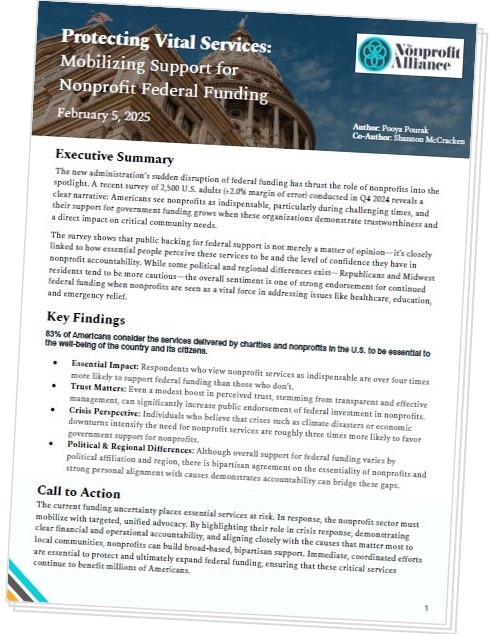
In Q4 2024, TNPA surveyed 2,500 U.S. adults to understand public attitudes toward nonprofit federal funding — research that comes at a crucial moment as our sector grapples with widespread disruptions to federal grants and programs.
Our study reveals several encouraging findings and point to clear actions we can take to protect and strengthen public support for federal funding. You can download the eight-page report here.
Related Blog Posts:
●The Government Shutdown’s Impact Will Continue for Nonprofits
●Regulatory Compliance: A Nonprofit Organization’s First Line of Defense
●Why it Matters: The Escalated and Unwarranted Targeting of the Nonprofit Sector
●Tax Reform & Charitable Giving: What It Means for Your Organization and Donors
●A Message from The Nonprofit Alliance President & CEO: Defending Our Sector’s Independence

February 10, 2026 | House Ways and Means Committee Hearing
The Nonprofit Alliance closely monitored the February 10 House Ways and Means full committee hearing on Foreign Influence in American Non-profits: Unmasking Threats from Beijing and Beyond. The February 3 hearing advisory included this: “House Committee on Ways and Means Chairman Jason Smith (MO-08) announced today that the Committee will hold a hearing on the ways foreign actors have funneled millions of dollars through networks of tax-exempt organizations to create, support, and fuel disruption and illegal activity across the country.”
House Ways and Means Chairman Jason Smith also sent a letter to the CEO of the National Future Farmers of America, claiming concerns about the use of DEI initiatives and raising questions about a partnership with a group with ties to the Chinese Communist Party.
The hearing showcased the troubling expansion of programming targeting of the nonprofit sector, building from similar member statements in multiple House committees in 2025. The Nonprofit Alliance (TNPA) was grateful to hear some general support for the nonprofit sector but was disappointed not to hear enough at the hearing about these critical issues: the stringent compliance requirements for nonprofit organizations that exists today, the critical services that the nonprofit sector has provided and continues to provide despite funding constraints, and a local nonprofit organizational perspective on their own work and the trust they have earned and maintained within their own communities.
The Nonprofit Alliance communicated with Congressional staff in advance of the hearing to reiterate the highest standards that the nonprofit sector holds, given its strong commitment to transparency and accountability.