Lab Notes: Why Your Leadership Needs a North Star
Research shows that up to 88% of people abandon their New Year’s resolutions before the end of January.[1] If you’re reading this now, there’s a good chance yours is already gathering dust, like many self-help books sold in December.
Here’s what I observed during this month’s Essential Leadership Lab session: senior nonprofit leaders don’t need another resolution to break. What we need is a compass: a single, guiding word that clarifies direction when everything else feels chaotic.
This post marks the beginning of “Lab Notes,” a monthly series where we share the discoveries and outcomes from our high-level cohort discussions to benefit the broader nonprofit community. This month, we explored the practice of choosing a “Word of the Year,” and why high-achieving executives, now more than ever, can benefit from a single anchoring theme to strengthen intentional leadership.
The Problem with Resolutions (Especially for Leaders)
Resolutions are punishing. They’re pass/fail goals that set us up for disappointment: read a book a week, forego desserts, never lose our temper in traffic. As Dr. Christopher W.T. Miller, an associate professor of psychiatry at the University of Maryland School of Medicine, explains, “There’s something that’s a bit demanding about resolutions. It automatically creates an expectation.”[2]
For nonprofit executives navigating federal funding shifts, donor trust erosion, and increased regulatory scrutiny, the last thing we need is more pressure. We’re already operating in environments where daily demands often drown out long-term strategy.
What we need instead is something “harmonizing and centering”[2] — a touchstone that helps us feel grounded when the winds pick up.
Enter the Guiding Word: Your Leadership North Star
A guiding word, what some call a “nudge word”[2], is a single theme you intentionally choose to shape your focus, priorities, and decisions for the year ahead. It’s not rigid. It’s not punishing. It’s a filter that brings direction without pressure, structure without rules.
A good word does three things:
●Clarifies your direction when life feels loud or overwhelming
●Simplifies decision-making by providing a steady reference point
●Creates momentum through consistency, even when things don’t go as planned
During our Lab session, I watched senior leaders move from initial skepticism to genuine clarity as they identified words that weren’t aspirational platitudes—they were strategic anchors for navigating real leadership challenges.
What We Discovered in the Lab
Discovery #1: The Best Words Emerge from Future Vision, Not Past Regret
There’s a natural inclination to choose words based on last year’s chaos or discomfort. But the leaders who found the most resonant words asked different questions: “Who am I becoming? What kind of year am I intentionally creating?” Some participants found it easier to envision their future state over a longer time horizon rather than just one year, which helped them identify the shift they needed to make now.
Discovery #2: Your Word Should Give You Permission to Stop
One of the “ah ha” moments in the Lab came within “The Permission Slip” exercise: “What is one leadership habit, commitment, or expectation that no longer serves me, and that my word gives me permission to release?” Very often, we add to our list of tasks and intentions without taking anything off, yet we’re already feeling at capacity. Intentional growth almost always requires deliberately choosing to stop doing something to make room for something new. In other TNPA programming, we’ve referred to this as “using our No to protect our Yes.”
As one participant put it, choosing a word isn’t just about adding something to your plate; it’s about clearing space for what matters.
Discovery #3: Words Reveal Themselves Through the Process
Several participants shared that the initial word they chose changed or was clarified during a peer counseling exercise in breakout rooms. Another connected some dots: the word he’d been circling around aligned perfectly with recent conversations about his career direction.
The words that emerged weren’t simply chosen from a list. They revealed themselves through repetition, through exploratory “pressure-testing” questions that made people sit up straighter, through the themes that kept circling back.
Discovery #4: Habit Formation Takes Longer Than You Think
When we discussed how to actually live your word throughout the year, I shared research from Scientific American showing that habit formation can take anywhere from 18 to 254 days — not the mythical 21 days we’ve all heard.[3] Missing a day or two doesn’t derail the process. What matters is returning to your intention. The intentional journey is the destination. Setting a daily calendar reminder with the word, putting it on a sticky note on the bathroom mirror, or using it as your computer wallpaper are small, sustainable integrations that set us up for success.
Why This Matters for Nonprofit Leaders Right Now
Nonprofit leaders are reporting burnout at record levels after a year that tested the resilience of not only organizations, but the individuals leading them. This practice of a guiding word allows for “both/and” leadership: you can acknowledge the difficulty of a season while staying focused on the momentum you are building. Your word becomes part of your narrative, a way to mark your growth with intention throughout the year.
It’s not about perfection. It’s about direction.
Words That Emerged
What emerged in our series of 90-minute cohort sessions were words like INSPIRE. DELIBERATE. THOUGHTFUL. DELIGHT. CONSISTENCY. FOCUS. PURPOSE. CONVICTION.
These leaders weren’t choosing words to “fix” themselves. They were choosing words to expand their capacity, protect their core commitments, and demonstrate the culture they want to see in their organizations.
Here’s what some of those words meant in practice:
INSPIRE: One Lab member chose this word to shift from a reactive to a more deliberate and authentic mindset, both personally and professionally, to help inspire others and foster a positive outlook—even when feeling unsure of their own ability to do so.
DELIBERATE: Another person selected this word while acknowledging their struggle with being more deliberate in her decisions, recognizing it as the shift that would unlock everything else.
THOUGHTFUL: A leader chose this word with the goal of being more thoughtful and patient, especially in their dual roles as a parent and organizational leader.
TRUST: One participant focused on both professional and personal growth, aiming to trust their team and themselves more, acknowledging the challenge of stepping outside their comfort zone to delegate and emphasizing the importance of trust during crises.
What struck me wasn’t just the diversity of words; it was how each one represented a fundamental shift in how these leaders wanted to show up. Their words become a filter for the next board meeting, the next strategic decision, the next moment of overwhelm.
Your Turn: Choosing Your Word
Here a simplified version of the framework we used in the Lab:
1. Look at who you are becoming, not who you were or who you “should” be.
2. Name the season you’re entering, not the one you’re leaving. Ask: “What kind of year am I intentionally creating?”
3. Identify the shift you need to make. Not goals. Shifts.
4. Pay attention to the word that keeps circling back.
5. Choose the word that feels simultaneously true and slightly uncomfortable. Growth rarely happens in comfort.
Once you have your word, make it visible. Share it with your management team or a colleague who can be your accountability partner. Use it as a filter for decisions: “Does this align with my word?” Build it into your leadership rhythms: quarterly reports, team meeting facilitation, annual performance reviews, etc.
And remember: your word isn’t about perfection. It’s about direction.
Join the Conversation
The insights shared in our Essential Leadership Lab are a testament to the power of peer-to-peer executive growth. Because this program is designed for deep, cohort-based learning, enrollment opens only three times a year … and it is open right now.
If you are a senior leader looking for a space to connect with peers for meaningful, facilitated conversations each month, I invite you to join our next cohort. Let’s build resilience together.
This is the first installment of Lab Notes, a monthly series dedicated to turning the high-level discussions of TNPA’s Essential Leadership Lab into actionable insights for the nonprofit sector.
Footnotes & Citations
[1] Richard Wiseman, “New Year’s Resolution Survey,” Quirkology, 2007. This is the primary source for the 88% abandonment statistic commonly cited in behavioral research.
[2] Angela Haupt, “10 Nudge Words to Adopt in 2026,” TIME, December 29, 2025, https://time.com/7339382/nudge-words-to-adopt-this-year/
[3] “How Long Does It Really Take to Form a Habit?” Scientific American, https://www.scientificamerican.com/article/how-long-does-it-really-take-to-form-a-habit/ (Original research by Phillippa Lally et al., University College London).

Author: Shannon McCracken
Shannon McCracken is the founding President and CEO at The Nonprofit Alliance.
Related Posts
Building Leadership Clarity at TNPA’s Leadership Summit 2026
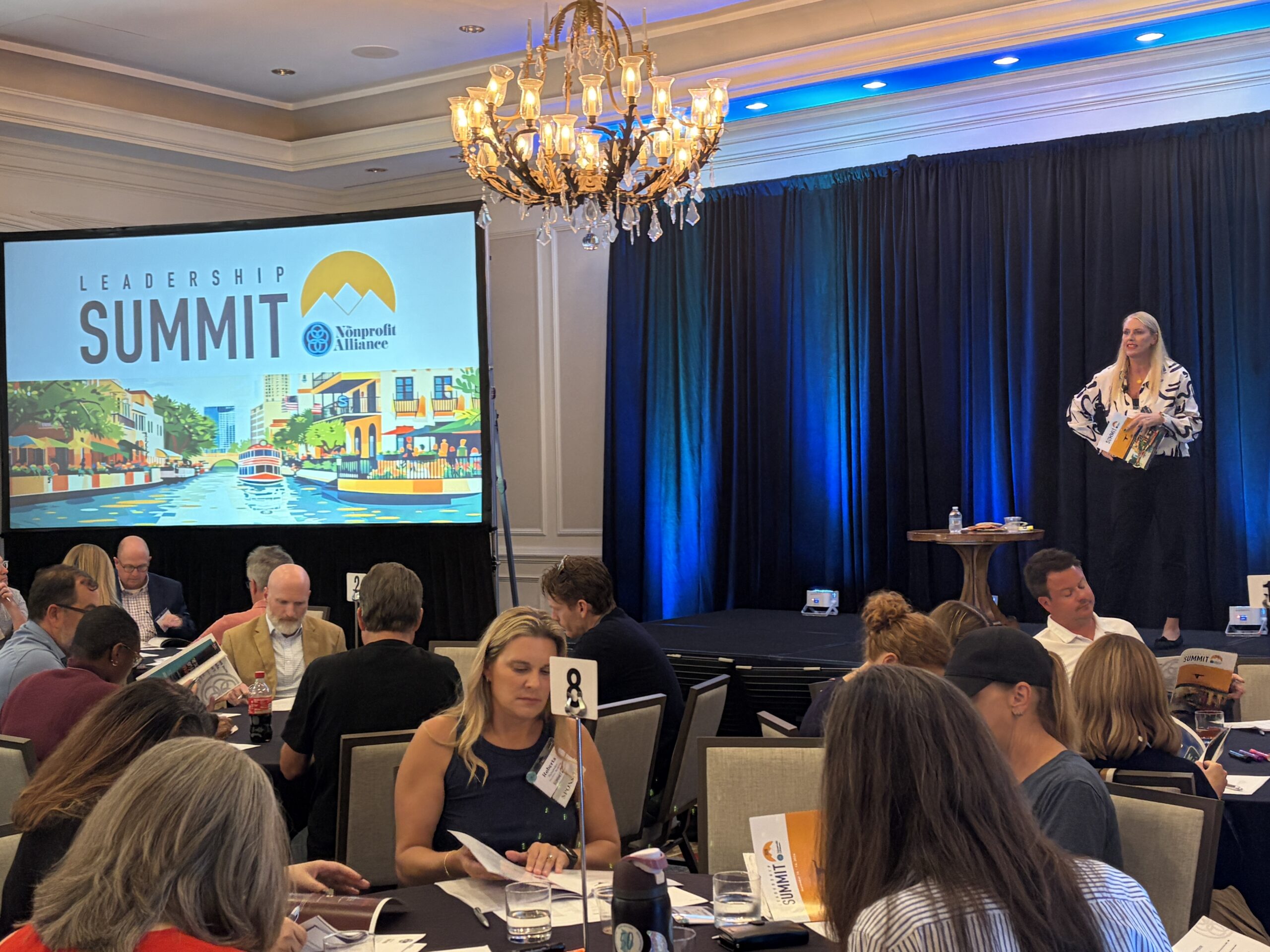
The team at The Nonprofit Alliance (TNPA) is thrilled to be in San Antonio, Texas, this week with more than 170 senior leaders from across the nonprofit sector. Against the backdrop of the beautiful Riverwalk, TNPA’s Leadership Summit 2026 has brought together a remarkable group of changemakers for an intensive, action-oriented experience designed to strengthen leaders, their teams, and the broader sector.
Leading EDGE Updates | August 2026
Check out our latest TNPA blog post for quarterly updates, including ways to get involved with our community of nonprofits, nonprofit-supporting companies, schools, and students who are passionate about making a difference through the social good sector!

Artificial Intelligence (AI) Policy Update
TNPA continues to work with policymakers regarding ethical AI priorities and we are closely tracking the implementation of the President’s AI plans.
We are also engaging our membership on educational opportunities as they navigate this fluid landscape, speaking with our nonprofit and commercial members regarding policy priorities which include…