Lab Notes: The Unbundling of the Fundraising Profession
May 2026 Essential Leadership Lab Cohort
Twenty-five years ago, the day-to-day responsibilities of the heads of development teams looked different than they do today. The ecosystem was more contained, and lines of accountability were clear.
That same role now orchestrates 30, 50, sometimes 100+ people across internal and external teams, technology platforms, and volunteer networks. The fundraising function hasn’t just grown, it’s been fundamentally disaggregated.
That’s the reality we examined in our May Leadership Lab: what it means to lead when the work you’re responsible for is distributed across an ecosystem you don’t fully control.
Coordination & Governance
We opened the session by asking participants to count everyone who touches their fundraising operation: internal staff, agency partners, consultants, service providers, volunteers. The numbers ranged from 15 to over 100.
Lab members reported that coordination overhead — meetings, status updates, alignment conversations — consume significant portions of their time and are core to their management responsibilities. Specialization brings competitive capabilities, including external expertise that organizations simply can’t, or shouldn’t, build in-house. But it comes with a coordination tax, the hidden cost of operating in an unbundled ecosystem. Every additional entity creates communication overhead, integration challenges, accountability gaps, and the risk of strategic drift when everyone optimizes their piece, but nobody optimizes the whole.
Chief development officers govern networks of internal and external actors. They design systems that enable others to cultivate donors. They make strategic decisions about resource allocation across the ecosystem. Success is measured by ecosystem performance and sustainability.
Agency partners split their time between the core work, extensive coordination meetings with clients, budget accountability, and what one participant described as serving as “a therapist to both clients and staff.” Another emphasized their role in helping clients shift from managing day-to-day operations to considering broader impacts.
We introduced four critical governance questions:
1.) Decision Rights: Who decides what?
2.) Integration Mechanisms: How do the pieces connect?
3.) Accountability Structures: Who owns outcomes?
4.) Innovation Protocols: How do you experiment?
Most organizations didn’t sit down and explicitly design these governance structures. They’ve evolved organically, which means some things happening right now are probably by default rather than distinct decision-making.
Mutual Understanding
One of the most valuable parts of the Lab was creating space for nonprofit leaders and agency partners to hear each other’s perspectives on what takes their time and what constraints they operate under.
From the agency side, participants emphasized the importance of logistics, like data formatting, database management, and the extensive planning required for campaigns. They noted the impact of last-minute changes when managing multiple clients simultaneously, and the challenge of serving as intermediaries handling client questions when clients don’t respond promptly to requests.
From the nonprofit side, participants explained the complexity of internal decision-making processes, particularly in marketing and communications collaborations and legal reviews where approvals can take weeks due to multiple layers of supervision and travel schedules.
One agency leader noted that while there is genuine appreciation and trust in client relationships, clients don’t fully grasp the complexity of agency work, and vice versa. The insight: this misunderstanding is inherent in agency-client relationships rather than a problem to be solved. Both sides are navigating constraints the other doesn’t fully see.
The discussion also surfaced how shifts in client culture or leadership can significantly impact agency relationships and require adaptation on both sides.
Pipeline
The conversation concluded with concerns about developing the next generation of fundraising professionals and whether the sector is intentionally creating pathways for future leaders to develop the ecosystem orchestration skills that senior roles now require. Multiple participants raised the challenge of pipeline development in a remote work environment. The informal learning that used to happen through proximity — overhearing phone calls, sitting in on meetings, absorbing organizational culture through daily interaction — has largely disappeared.
The concern extends beyond individual organizations to the profession itself: as fundraising has become more specialized, the next generation may be learning narrow slices of work without understanding how the whole ecosystem functions- a gap that becomes critical as they move into leadership roles. In-person networking, benchmarking, and industry events that foster professional development and soft skills growth, therefore, take on even greater importance.
What This Means for Leaders
Several commitments emerged from the Lab discussions:
Review governance structures. Where necessary, explicitly design and document decision rights, integration mechanisms, accountability structures, and innovation protocols for programs, ensuring clarity and resilience through staff and leadership transitions.
Create intentional learning opportunities. Particularly in remote and hybrid environments, proactively support opportunities for junior and mid-level staff to participate in networking, benchmarking, and cross-organizational collaboration.
Have transparent conversations about AI. Agency leaders committed to initiating proactive discussions with clients regarding AI use and implications, including efficiency gains, cost expectations, and required buy-in for new processes.
Evaluate meeting structures. Several participants discussed experimenting with meeting-free time blocks to protect focus time, though acknowledging the challenges of maintaining these boundaries when urgent needs arise.
Bottomline: Leaders who can orchestrate complexity, rather than be overwhelmed by it, will define what’s possible for their organizations and the sector.
About The Essential Leadership Lab
The Essential Leadership Lab is a cohort-based program for nonprofit leaders, providing practical frameworks and peer learning opportunities to address the real challenges facing the sector. Each month, we tackle topics that matter most to leaders navigating complexity and change.
Interested in joining a future Lab cohort? Contact us to learn more about upcoming sessions.
Lab Notes is a monthly series that turns the high-level discussions of TNPA’s Essential Leadership Lab into actionable insights for the nonprofit sector.

Author: Shannon McCracken
Shannon McCracken is the founding President and CEO at The Nonprofit Alliance.
Related Posts
Building Leadership Clarity at TNPA’s Leadership Summit 2026
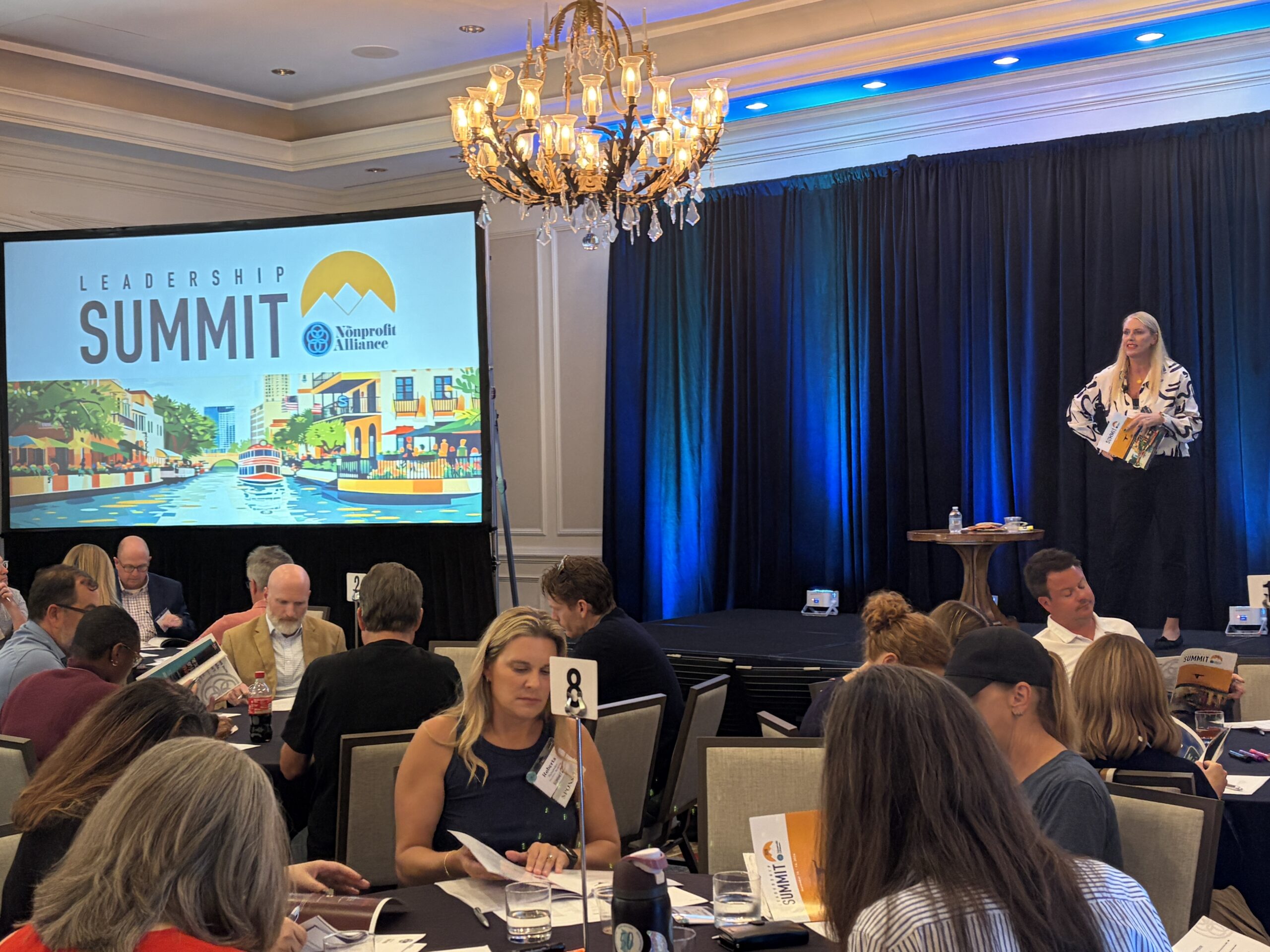
The team at The Nonprofit Alliance (TNPA) is thrilled to be in San Antonio, Texas, this week with more than 170 senior leaders from across the nonprofit sector. Against the backdrop of the beautiful Riverwalk, TNPA’s Leadership Summit 2026 has brought together a remarkable group of changemakers for an intensive, action-oriented experience designed to strengthen leaders, their teams, and the broader sector.
Leading EDGE Updates | August 2026
Check out our latest TNPA blog post for quarterly updates, including ways to get involved with our community of nonprofits, nonprofit-supporting companies, schools, and students who are passionate about making a difference through the social good sector!
Artificial Intelligence (AI) Policy Update
TNPA continues to work with policymakers regarding ethical AI priorities and we are closely tracking the implementation of the President’s AI plans.
We are also engaging our membership on educational opportunities as they navigate this fluid landscape, speaking with our nonprofit and commercial members regarding policy priorities which include…