
Lab Notes: Risk and Rewards
Insights from February’s Leadership Lab on Risk Management and Risk Stewardship
There’s a peculiar contradiction at the heart of nonprofit leadership: we are operating in one of the highest-risk environments most of us have witnessed in our careers, yet we perceive the sector as fundamentally risk-averse.
Last month’s Leadership Lab explored that tension head-on, exploring the idea that the greatest risk many nonprofit leaders face isn’t taking a bad risk … it’s not taking enough good ones.
Nonprofit sector leaders are responsible for two fundamentally different types of risk work:
●Risk Management (Defense): Protecting against existential threats, including data breaches, federal funding cuts, reputational crises, and financial collapse. These are risks imposed on us that must be mitigated.
●Risk Stewardship (Offense): Enabling strategic innovation, like testing new fundraising channels, piloting unproven programs, and entering new markets. These are risks we choose that should be managed.
These aren’t opposites. They’re teammates.
Strong risk management gives organizations the credibility to take the right risks. Risk mitigation enables risk-taking. Donors trust you to be good stewards. Boards trust you to try new things. Funders give you flexibility. You become the organization that can move quickly when opportunities arise.
The sector’s reputation for risk aversion doesn’t match the reality. Nonprofits operate at extraordinarily high-risk levels. The question isn’t whether to take risks — it’s which risks to take and how to take them intelligently.
I ran a small experiment with everyone from the cohort in attendance across all sessions of Lab in February. At different points in the session, I asked participants to choose an emoji representing their feelings about risk. Early in the conversation, before diving into the landscape of modern threats, responses reflected curiosity and openness. After walking through eight categories of organizational risk, positivity declined noticeably.
The insight? Timing and framing matter. A “no way” during crisis planning could become a “let’s explore this” when the conversation is framed differently. We’re more open to risk in day-to-day contexts than when we’re in threat-assessment mode.
This has implications for how we lead. If every risk conversation happens in the context of “what could go wrong,” we steer ourselves and our teams toward paralysis. If we can reframe some of those conversations around “what becomes possible,” we open different doors.
And then there’s the category of risk that we don’t talk about as much: personal risk. The weight leaders carry rarely get named in professional settings.
We identified five categories:
●Perception and credibility risk: Fear of appearing weak when making hard or unpopular decisions, or reckless when championing innovation
●Psychological and emotional risk: Imposter syndrome, decision fatigue, isolation
●Career and identity risk: When your sense of worth becomes intertwined with organizational outcomes
●Decision-making risk: The weight of being the final decision-maker
●Health and sustainability risk: The physical and mental toll of sustained crisis leadership
In breakout discussions, the challenge of maintaining credibility while taking necessary risks and the difficulty of separating personal identity from organizational performance surfaced repeatedly.
Personal risk is organizational risk. When leaders burn out, make fear-based decisions, or lose their visionary edge, the entire organization suffers.
The Bottom Line
The nonprofit sector didn’t attract us because we wanted to play it safe. We got into this work to make a difference, to be bold, and to pursue what’s possible.
But somewhere along the way, many of us started confusing “responsible stewardship” with “risk avoidance.”
The organizations that will thrive in this complex environment are those that build resilience to weather threats and confidence to pursue opportunities.
The riskiest move of all is standing still.
The Leadership Lab is a monthly peer learning experience for nonprofit executives navigating the complexities of modern leadership. March’s session continues our exploration of critical leadership challenges, and April is our designated “Hot Topic” month. Leadership is risky. But it’s a lot less risky when you’re not doing it alone.
Lab Notes is a monthly series that turns the high-level discussions of TNPA’s Essential Leadership Lab into actionable insights for the nonprofit sector.

Author: Shannon McCracken
Shannon McCracken is the founding President and CEO at The Nonprofit Alliance.
Related Posts
Building Leadership Clarity at TNPA’s Leadership Summit 2026
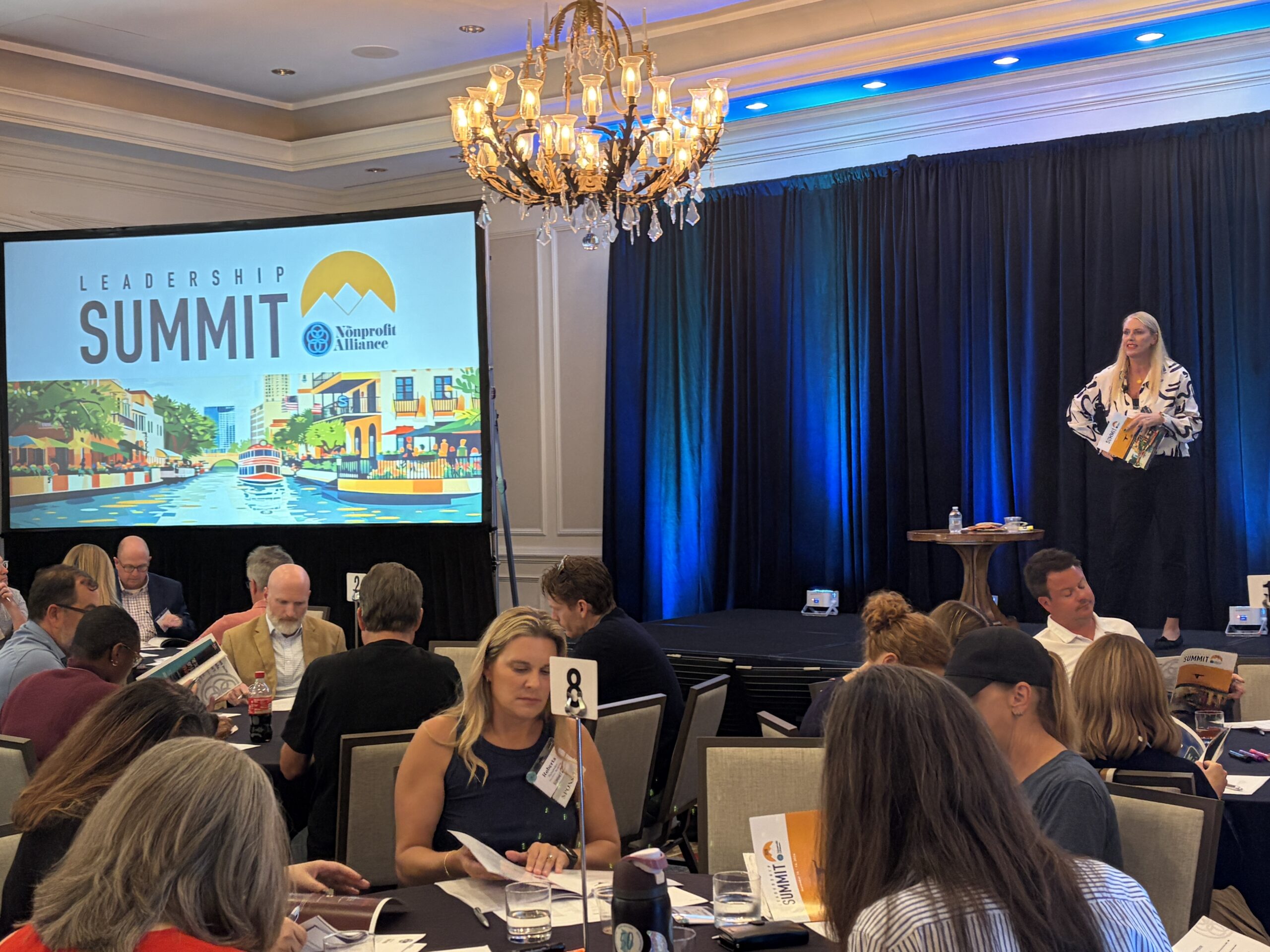
The team at The Nonprofit Alliance (TNPA) is thrilled to be in San Antonio, Texas, this week with more than 170 senior leaders from across the nonprofit sector. Against the backdrop of the beautiful Riverwalk, TNPA’s Leadership Summit 2026 has brought together a remarkable group of changemakers for an intensive, action-oriented experience designed to strengthen leaders, their teams, and the broader sector.
Leading EDGE Updates | August 2026
Check out our latest TNPA blog post for quarterly updates, including ways to get involved with our community of nonprofits, nonprofit-supporting companies, schools, and students who are passionate about making a difference through the social good sector!

Artificial Intelligence (AI) Policy Update
TNPA continues to work with policymakers regarding ethical AI priorities and we are closely tracking the implementation of the President’s AI plans.
We are also engaging our membership on educational opportunities as they navigate this fluid landscape, speaking with our nonprofit and commercial members regarding policy priorities which include…