Lab Notes: The Shifting Fundraising Landscape
August 2026 Essential Leadership Lab Cohort
Our August Leadership Lab invited discussion of today’s fundraising landscape, and pretty quickly all four cohorts diagnosed a period of intense economic and operational pressure and a K-shaped revenue landscape: while high-wealth giving through sophisticated third-party vehicles is surging, we are seeing a continued and concerning decline in everyday, lower-dollar givers.
Federal funding pullbacks, the rising costs of traditional channels, and the continued erosion of the small-dollar donor base have created a fundraising investment balance that’s also K-shaped. On one hand, nonprofits are investing in new strategies to steward more meaningful relationships with higher capacity donors. On the other, they are leaning into maximizing efficient transactional strategies that are predictable, reliable, and considered safely within the realm of industry best practices. In some cases, it’s either/or, but for most it’s both/and, striking a balance within spending budgets that aren’t necessarily larger but with room to allocate where needed for maximum – but safe – revenue forecasting.
The ultimate test for any of these strategies and practices isn’t ROI. It’s the trust test: If you explained the art and science of your fundraising ask to your donors, would they feel gratified?
There wasn’t clear consensus among our Lab participants. Reasonable leaders disagree. Some spoke about sophisticated resource allocation as a fiduciary responsibility to the mission. Others were more sensitive to the question, having lived a cautionary tale or, like one Lab member, debating at the moment we met how to manage a donor’s complaint that, itself, crossed an invisible line of acceptability.
This conversation takes on a new urgency when viewed through the lens of AI. We are at an inflection point where AI will automate these very practices at a scale and speed we barely recognize. AI will optimize around the ethics we hand it. We risk encoding our most transactional impulses, those we rely on when the fundraising landscape is at its most perilous, into systems that will amplify them exponentially. Innovating faster than accountability can keep up is a risky enterprise for a sector whose operating model runs on public trust.
All four cohorts ended their conversations on how to maintain momentum for staff teams during periods of high uncertainty, as the past few years in the fundraising arena certainly have felt. The insights from the Lab suggest focusing on three controllable factors:
- Connecting Fundraising to Program: Breaking down the silos between those who raise the money and those who spend it. When fundraisers see the direct impact and program staff understand that generosity isn’t a certainty, the mission vs. money tension becomes a shared responsibility.
- Celebrating Small Wins: In a challenging economy, momentum is easily lost. Leaders must amplify victories that aren’t just about the bottom line, but about mission alignment and donor trust.
- Honest Communication: Maintaining team morale requires a radical transparency about the challenges, anchored by a refusal to let the pressure of the moment dictate the ethics of the organization.
The Bottom Line
The funding landscape has shifted, and the “us” that survives this shift must be an “us” that our donors and our teams still recognize. Whether it’s navigating the rise of DAFs or the implementation of AI, the goal is the same: to ensure that our efficiency never comes at the cost of the trust that makes our work possible.
Want to join the conversation? The Essential Leadership Lab is a space for senior nonprofit leaders to pressure-test strategies and explore questions of leadership in a safe, peer-led environment. Our cohorts meet monthly to dive deep into the topics that matter most to the sector’s future. Enrollment opens three times a year, with the next cycle opening in September. Visit tnpa.org/lab/ for more information.

Author: Shannon McCracken
Shannon McCracken is the founding President and CEO at The Nonprofit Alliance.
Related Posts
Building Leadership Clarity at TNPA’s Leadership Summit 2026
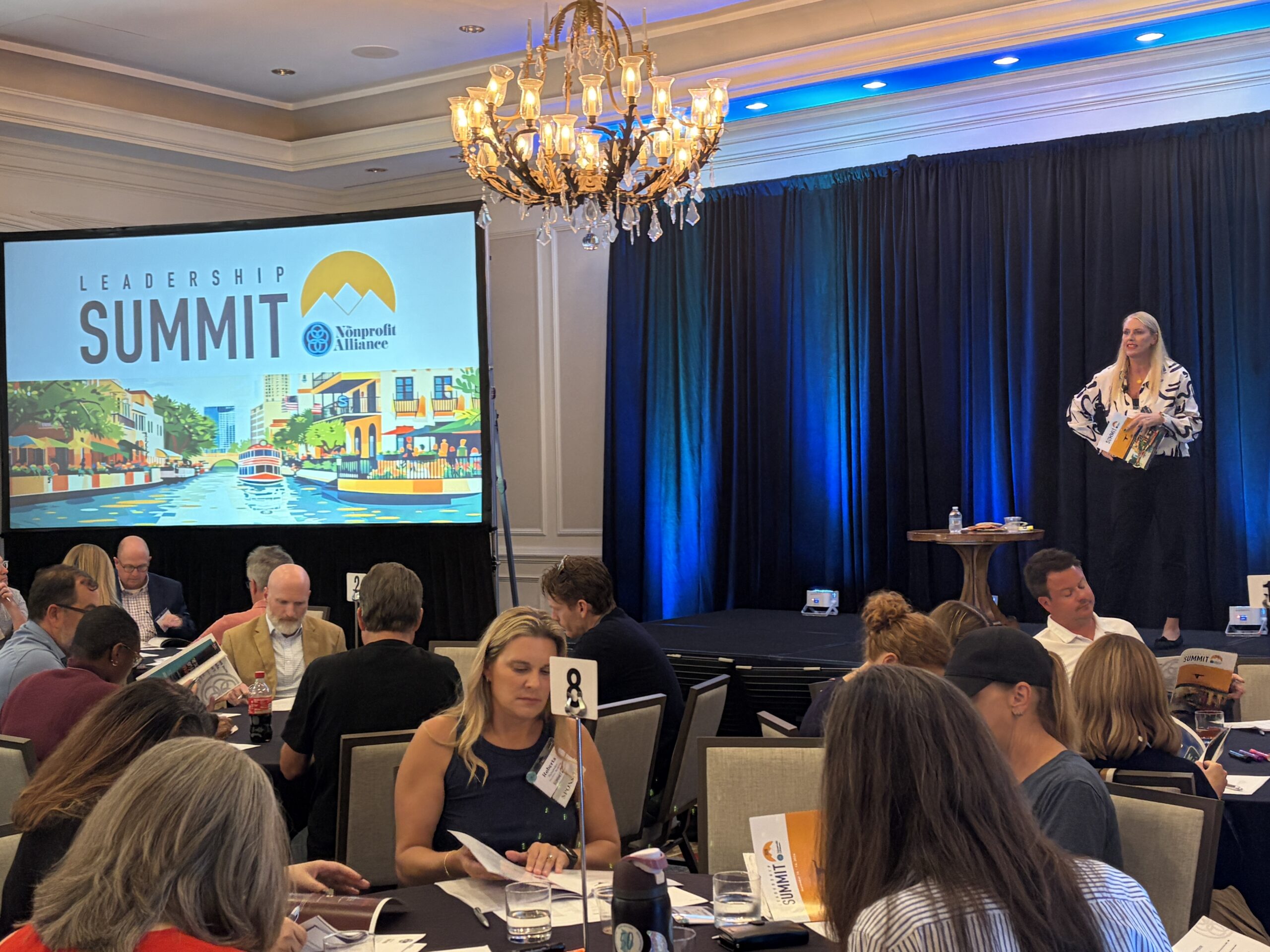
The team at The Nonprofit Alliance (TNPA) is thrilled to be in San Antonio, Texas, this week with more than 170 senior leaders from across the nonprofit sector. Against the backdrop of the beautiful Riverwalk, TNPA’s Leadership Summit 2026 has brought together a remarkable group of changemakers for an intensive, action-oriented experience designed to strengthen leaders, their teams, and the broader sector.
Leading EDGE Updates | August 2026
Check out our latest TNPA blog post for quarterly updates, including ways to get involved with our community of nonprofits, nonprofit-supporting companies, schools, and students who are passionate about making a difference through the social good sector!

Artificial Intelligence (AI) Policy Update
TNPA continues to work with policymakers regarding ethical AI priorities and we are closely tracking the implementation of the President’s AI plans.
We are also engaging our membership on educational opportunities as they navigate this fluid landscape, speaking with our nonprofit and commercial members regarding policy priorities which include…